Historic timber structures and red Georgia clay create persistent subfloor moisture issues across Fulton County. Homes built over dirt crawl spaces in neighborhoods like Inman Park, Grant Park, and Cabbagetown…
Historic timber structures and red Georgia clay create persistent subfloor moisture issues across Fulton County. Homes built over dirt crawl spaces in neighborhoods like Inman Park, Grant Park, and Cabbagetown regularly absorb ground moisture that evaporates directly into framing timbers, elevating wood moisture content above the critical 20% threshold where fungal rot and subterranean termites initiate colonization. Unsealed foundation vents allow hot, saturated summer air from the Piedmont Park and Atlanta Botanical Garden basins to enter cooler subfloors, causing condensation along cold HVAC ductwork and subfloor sub-assemblies. Encapsulation resolves this mechanism by isolating the house entirely from subterranean soil moisture and damp ambient air.
Selecting crawl space encapsulation over basic dirt-floor poly sheeting depends on long-term structural intentions and relative humidity goals. A loose 6-mil plastic ground cover reduces base soil evaporation, but unsealed foundation vents and bare masonry perimeter walls in West End or Kirkwood still admit humid outdoor air that fuels wood-decay fungus and draws wood-boring pests. Full encapsulation costs more initially due to commercial dehumidifier equipment and perimeter wall sealing, but it permanently stabilizes relative humidity below 55%, preventing wood rot and structural joist sagging without locking homeowners into predatory, 12-month national chain subscription traps. The physical investment trades open exterior airflow for controlled, sealed environmental stability beneath the subfloor.
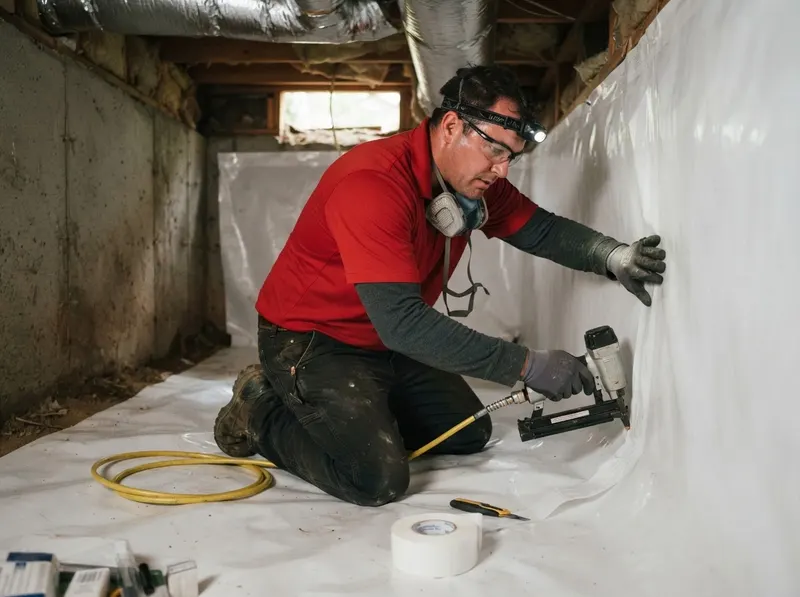
Installation follows a systematic structural protocol. Technicians clear fallen debris, rake the clay floor level, and treat any surface fungal growth on pine joists with botanical biocides. A durable, tear-resistant 12-mil or 20-mil woven poly vapor barrier covers 100% of the ground, running upward 6 to 12 inches along brick or concrete masonry unit foundation walls, secured with mechanical fasteners and masonry-grade mastic. Technicians seal all exterior wall vents with insulated plugs and finish the installation by wiring an energy-efficient dehumidifier with a digital hygrometer to exhaust condensed water safely to the home exterior via continuous drain lines.
Every job gets a firm, written price after a free on-site visit.
Tell us about your crawl space encapsulation and vapor control job in Atlanta and we'll send a clear, written quote, usually the same day.
 Peachtree Falcon Pest Control